


What are Corvette NOS side exhaust pipes and why are they critical for C2 Corvette restorations?
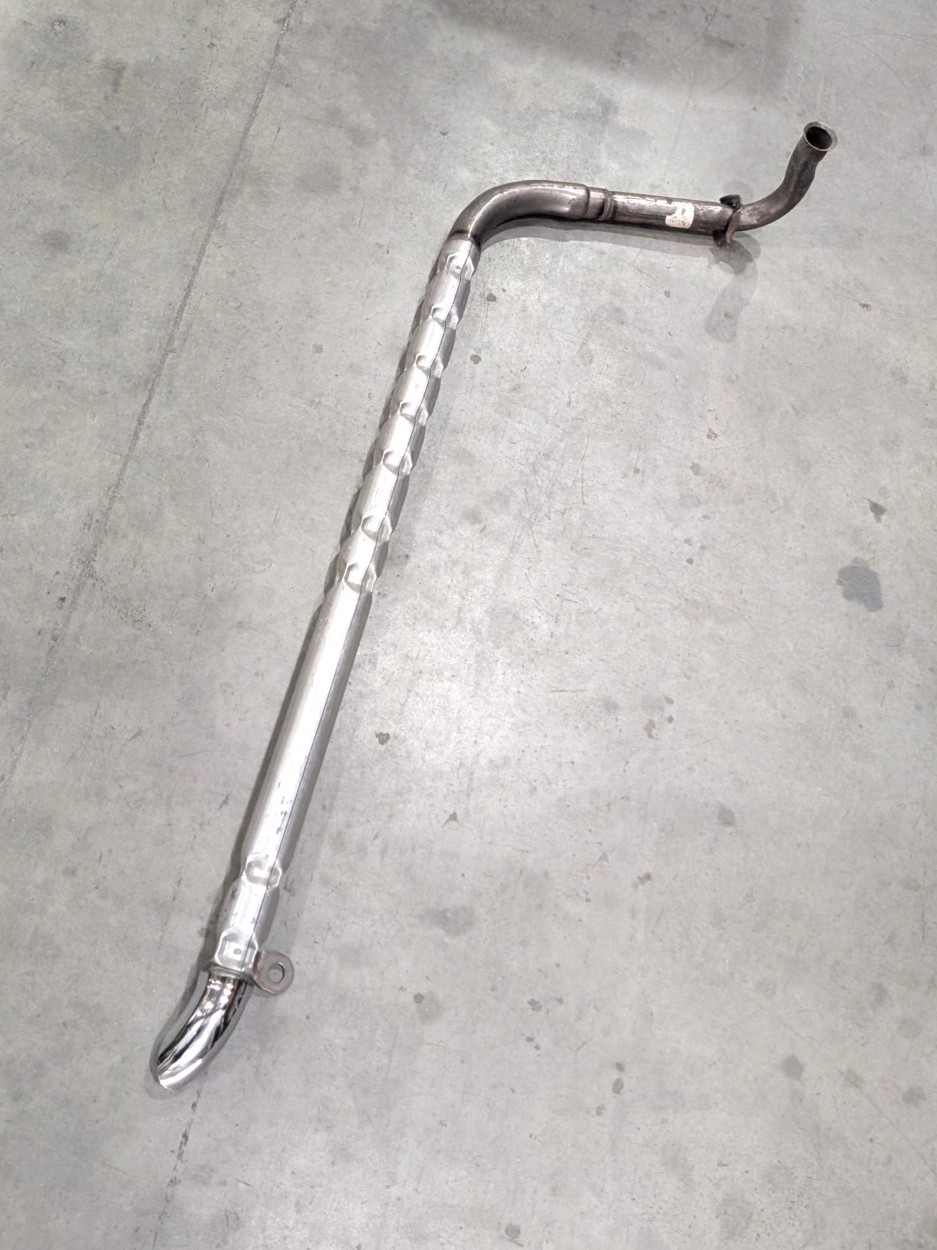
Corvette NOS side exhaust pipes are genuine General Motors factory-manufactured exhaust components produced during the second-generation (C2) Corvette production era (1963–1967) that were never sold or installed on a production vehicle. They are critical for C2 Stingray restorations because they feature exact St. Louis assembly line manufacturing characteristics.
These include factory spot-weld patterns, original chambered internal baffle profiles, precise bend radii, and stamped GM part numbers (such as #3877215, #3872971, and #3872972).
Installing genuine NOS side pipes prevents point deductions during high-level National Corvette Restorers Society (NCRS) Top Flight and Bloomington Gold certification judging, ensures direct bolt-on clearance against frame rails and steering linkages, and preserves long-term collector market valuation.

Preserving NCRS Judging Authenticity with Factory GM Part Numbers
Achieving top-tier honors at National Corvette Restorers Society (NCRS) Chapter, Regional, or National meets—as well as securing Bloomington Gold Certification—demands an uncompromised dedication to original assembly line specifications. During technical flight judging, NCRS master judges meticulously examine the underside of the C2 chassis, evaluating everything from frame finish and fastener headmarks to exhaust tube contours and baffle construction.
Aftermarket headers, reproduction pipes, and universal commercial mufflers quickly reveal themselves during close inspection. Common discrepancies that trigger mandatory scoring deductions include:
- Incorrect Seam and Spot-Weld Geometry: Modern reproduction pipes typically utilize robotic continuous MIG welds along outer tubing and bracket connection points, whereas original GM assembly line pipes feature distinct automated resistance spot-welds and crushed-seam baffle retention marks.
- Inaccurate Tube Bending and Flattening: Original GM fabricators utilized specific mandrel hydraulic bending presses that created slight, controlled flattening along specific frame rail transitions for clearance. Modern CNC mandrel benders produce uniform round cross-sections that do not match original factory profiles.
- Non-Period Internal Acoustics: Aftermarket systems frequently swap original internal chambered baffle designs for perforated core packing, creating artificial cabin drone or modern exhaust notes that deviate from the crisp, metallic rasp intended by Duntov’s Chevrolet engineering team.
Sourcing genuine New Old Stock (NOS) factory components completely eliminates technical judgment discrepancies. Manufactured on original GM tooling and preserved in vintage warehouse packaging, NOS pipes retain exact physical signatures, precise metal gauge thickness, and original mounting bracket alignments.
Microclimate & Micro-Geography Considerations: Protecting C2 Exhaust Systems
The physical preservation and installation environment of a C2 Corvette side exhaust system is heavily influenced by regional humidity, salt exposure, and local climate factors across North America.
- Coastal & Marine Environments (e.g., Monterey Peninsula, Gulf Coast): High ambient salt air accelerates surface flash rust on unpainted bare steel NOS exhaust tubing and cast-iron manifolds. When storing NOS components or displaying show vehicles in coastal regions, high-temperature clear preservatives or climate-controlled dehumidified storage (under 40% RH) are required to protect microscopic factory surface finishes.
- Humid Midwestern / East Coast Belts (e.g., St. Louis, MO; Hershey, PA): Extreme seasonal humidity swings encourage moisture collection within the unsealed internal chambered baffles during short engine runs. Unburned condensation acidic residue rapidly corrodes internal baffle plates from the inside out. Vehicles stored in these microclimates should be brought to full operating temperature ($180^\circ\text{F} – 200^\circ\text{F}$) during every operational start to purge trapped internal water vapor.
- Arid Desert & High-Heat Regions (e.g., Scottsdale, AZ; Palm Springs, CA): While atmospheric moisture corrosion is minimal, high ambient road surface temperatures ($120^\circ\text{F}+$) accentuate thermal radiation from side pipes into fiberglass rocker sills. Proper installation of original fiberglass heat shielding insulation and maintaining exact 38-inch air-gap clearances behind chrome rocker panel covers is imperative to avoid paint blistering on low-hanging fiberglass sills.
2-Inch vs. 2.5-Inch GM Side Exhaust Technical Comparison
Selecting the correct pipe diameter requires aligning GM factory part numbers, engine block displacement, intake induction, and exhaust manifold flange dimensions. Mid-year Stingrays (1963–1967) used two distinct side exhaust tube diameters depending on horsepower rating and cylinder block architecture.
How do 2-inch and 2.5-inch C2 Corvette side exhaust pipes differ in fitment and performance?
C2 Corvette 2-inch side exhaust pipes (such as LH GM #3877215) were engineered for standard 327 cu. in. small-block V8 engines with 2-inch manifold outlets, offering maximum low-end torque backpressure and tight clearance around steering linkage components.
In contrast, 2.5-inch side exhaust pipes (LH GM #3872971 / RH GM #3872972) feature wider diameter tubing designed specifically for high-output small-block (L76, L79, L84) and big-block 396/427 V8 engines (L36, L68, L71, L72, L88) equipped with 2.5-inch manifold outlets to maximize exhaust gas velocity, thermal dissipation, and high-RPM horsepower.
| Feature / Metric | 2.00-Inch Side Exhaust Configuration | 2.50-Inch Side Exhaust Configuration |
|---|---|---|
| Primary GM Part Numbers | LH GM #3877215 / RH GM #3877216 | LH GM #3872971 / RH GM #3872972 |
| Applicable Model Years | 1965–1967 (Direct Fit); 1963–1965 (Retrofit) | 1965–1967 (Direct Factory Fit) |
| Engine Compatibility | Base 327 cu. in. Small-Block V8 (250 HP, 300 HP) | High-Output 327 V8 (350 HP, 365 HP, 375 HP) & 396 / 427 Big-Block V8 |
| Manifold Outlet Flange | 2.00-Inch Outlet Diameter | 2.50-Inch Outlet Diameter |
| Steering Linkage Clearance | Standard clearance around Steering Gear Box | Tight tolerance; relies on precise factory bend radius |
| Backpressure / Scavenging | Higher backpressure; optimized for street torque | Lower backpressure; optimized for high-RPM exhaust flow |
| Acoustic Profile | Deep, smooth mechanical rumble | Sharp, resonant metallic exhaust bark under load |
| NCRS Flight Point Value | Full Originality Credit for Base 327 Builds | Full Originality Credit for High-HP Small-Block & Big-Block |
Step-by-Step Installation & Aligning Heat Shields
Achieving a stress-free, show-ready installation of NOS side exhaust pipes demands a systematic approach. Improperly hung pipes stress delicate cast-iron manifold studs, vibrate against frame rails, and char lower fiberglass body sills.
Installation Procedure for Corvette NOS Side Exhaust Pipes
- Prepare Manifold Outlets and Flange Hardware: Inspect the cast-iron exhaust manifold outlet bevels. Ensure all carbon build-up is removed using wire wheel brushes. Thread new grade-8 exhaust studs into the manifolds using anti-seize compound.
- Mock-Up Frame Mount Bracket Alignment: Lift the NOS side pipe into position beneath the vehicle chassis. Loosely attach the center and rear frame mounting tabs to the frame crossmember brackets using correct OEM rubber-isolated biscuits and washers. Leave fasteners hand-tight to allow axial flotation.
- Align and Seat Flange Interface: Guide the upper pipe header flange over the manifold studs. Insert high-temperature donut gaskets (or verify metal-to-metal seating for early French-lock designs). Finger-tighten flange nuts evenly to ensure the pipe throat centers perfectly over the manifold orifice without pulling or binding.
- Establish Heat Shield Air-Gap Margins: Before torquing down hardware, position the fiberglass inner heat shields and outer chrome rocker panel covers. Verify a uniform 38-inch clearance envelope between the outer pipe casing and the fiberglass side sill along the entire length of the body cutout.
- Final Sequence Torquing: Torque manifold flange nuts in an alternating sequence to 25-30ft-lbs. Next, tighten frame mounting brackets to 18-22ft-lbs, ensuring rubber isolators compress evenly without distorting the mounting tabs. Start the engine and verify leak-free operation prior to final chrome cover mounting.
Frequently Asked Questions About Corvette NOS Side Exhaust Pipes
What does “NOS” stand for in C2 Corvette restorations?
“NOS” stands for New Old Stock. It refers to original factory components manufactured by General Motors (or its authorized period subcontractors) during the 1960s C2 Corvette production era that were shipped to dealer service departments or inventory warehouses but were never previously installed on a vehicle. NOS parts provide authentic material quality, factory weld geometry, and exact fitment that reproduction parts struggle to replicate.
How can I verify if my C2 Corvette side exhaust pipes are genuine GM NOS?
Genuine GM NOS side exhaust pipes feature distinct identification markers: stamped or metal-tagged GM part numbers (such as #3877215 for 2-inch LH or #3872971 for 2.5-inch LH), automated spot-weld indentations along the seam lines rather than continuous bead MIG welds, original factory steel gauge thicknesses, and authentic internal chambered baffle assemblies rather than modern glass-pack or perforated core interiors.
Can 2.5-inch side exhaust pipes be installed on a base 327 small-block C2 Corvette?
Yes, 2.5-inch side exhaust pipes can be installed on a base 327 small-block C2 Corvette, provided the original 2-inch exhaust manifolds are swapped for 2.5-inch outlet manifolds (standard on high-horsepower small-block and big-block engines). However, for strict NCRS Flight Judging, a base 327 engine optioned from the factory with standard exhaust should retain 2-inch piping (GM #3877215/16) to avoid originality point deductions.
Why do aftermarket C2 side exhaust pipes cause fiberglass paint damage?
Aftermarket C2 side exhaust pipes frequently cause fiberglass paint damage due to improper tube bending radii and misaligned mounting bracket locations. These manufacturing inaccuracies force the exhaust tubing too close to the fiberglass body sills, reducing the critical air gap beneath the rocker covers. Under load, thermal expansion radiates excessive heat ($400^\circ\text{F}+$) directly into the bodywork, resulting in paint blistering, fiberglass cracking, and resin delamination.
