


What Are Rare NOS Corvette Side Exhaust Pipes and What Can They Provide for C2 Restorations?
Rare NOS (New Old Stock) Corvette side exhaust pipes are original General Motors factory-manufactured exhaust components that were produced during the vehicle’s production era (such as 1965–1967 for C2 RPO N14 systems) but were never sold, installed, or run on an engine. Unlike modern aftermarket reproductions or universal chambered pipes, authentic NOS GM side exhaust pipes feature original assembly-line mandrel bends, internal multi-stage baffle configurations, heavy-gauge aluminized steel, and factory tooling stamps. They are essential for historical restorations because they guarantee zero chassis interference, eliminate cabin acoustic resonance, meet strict National Corvette Restorers Society (NCRS) and Bloomington Gold judging standards, and preserve correct exhaust scavenging and backpressure for small-block and big-block V8 powerplants.
Preserving the pedigree of America’s premier sports car demands uncompromising dedication to historical accuracy. When undertaking a frame-off rotisserie build or prepping for top-flight judging, locating authentic NOS Corvette side exhaust pipes and original GM parts forms the foundation of a historically significant project.
Factory engineering established a balance of acoustic resonance, scavenging velocity, and frame-rail clearance that modern reproduction fabrications struggle to duplicate.
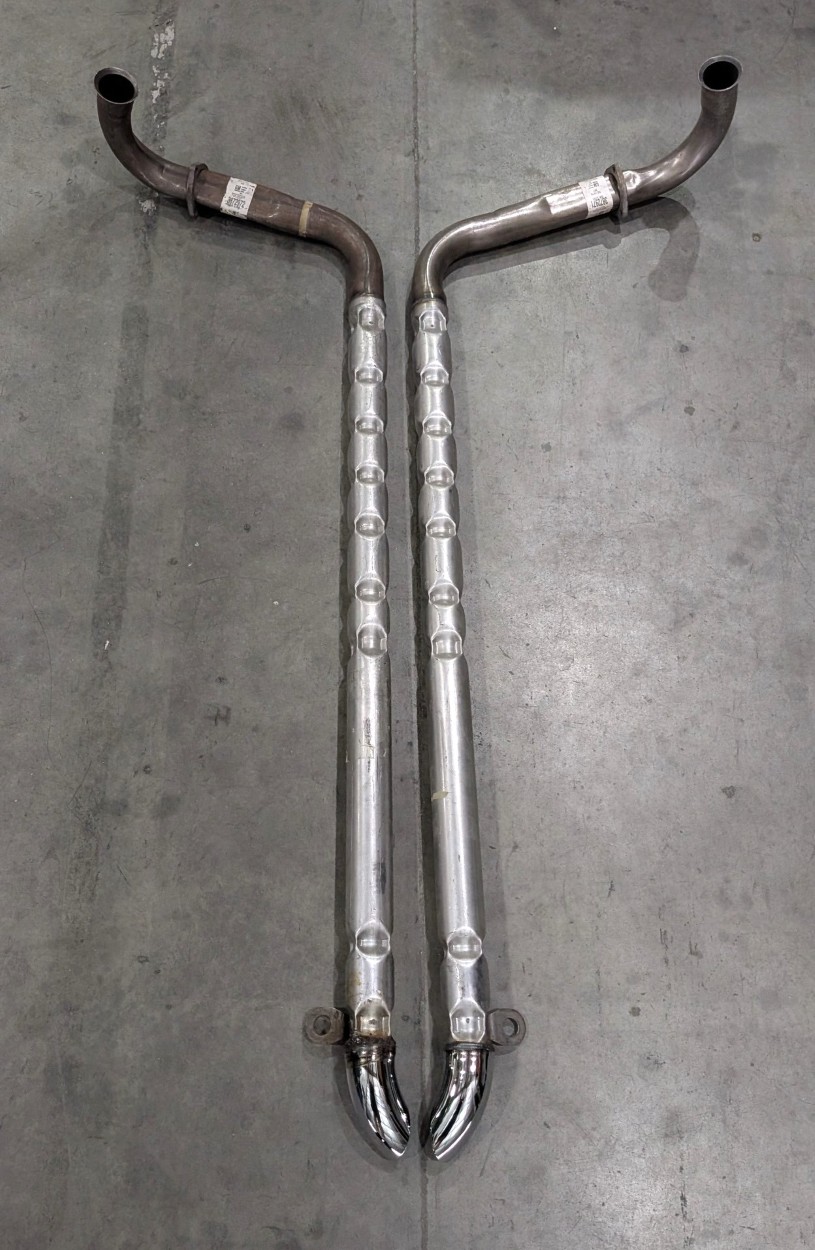
At CS of MD West, we supply dedicated collectors and professional restoration shops with preserved original equipment manufacturer (OEM) inventory, ensuring your midyear Sting Ray or early shark Corvette performs, looks, and sounds precisely as it did departing the historic St. Louis assembly plant.
Our inventory focuses on components preserved in dry storage, paired with authentic factory hardware and specialized in-house instrument restoration.
Unlike scrap yards or online auction sites that distribute fatigued components subjected to thermal cycling and rust degradation, our team curates genuine new-old-stock components that protect your classic’s structural integrity and auction valuation.
The Engineering Mechanics of Midyear Corvette Side Exhaust Systems
Chevrolet introduced the iconic RPO N14 side-mount exhaust system in 1965. Designed under the direction of Zora Arkus-Duntov, this option transformed both the aesthetics and the thermodynamic profile of the C2 Sting Ray. Unlike standard under-car routing—which directed exhaust gases through intermediate pipes, frame crossmember pass-through holes, and rear transverse mufflers—the side exhaust system routed gases immediately outward beneath the fiberglass rocker panels.
The functional heart of the N14 option is its chambered pipe design. Rather than relying on a separate stamped muffler shell packed with fiberglass matting, the side exhaust pipe functions as its own silencing element. The pipe transitions into an expanded casing containing a series of internal baffles, flutes, and sound attenuation chambers.
When high-velocity exhaust pulses exit the cylinder heads, they encounter these internal chambers. The sound waves bounce and partially cancel each other out through destructive wave interference, softening harsh frequency spikes while retaining the mechanical exhaust note. Modern generic aftermarket pipes typically feature crude indentations stamped directly into standard thin-wall exhaust tubing.
These generic bends create restrictive pinch points, alter pulse frequency, and introduce intolerable cabin drone between 2,200 and 2,800 RPM. Authentic GM pipes feature precisely calculated chamber volumes that scavenge cylinder gases efficiently and yield the crisp metallic bark historic Corvettes are known for.
Specification Analysis: NOS GM vs. Aftermarket vs. Salvaged Exhaust Systems
Choosing the correct exhaust system dictates whether a Corvette clears chassis outriggers smoothly or suffers from persistent rattles, backpressure imbalance, and deduction marks on the judging field.
| Engineering Metric | Authentic NOS GM Exhaust (RPO N14) | Modern Aftermarket / Universal | Salvaged / Used Original GM |
|---|---|---|---|
| Tubing Wall Thickness | Heavy-gauge aluminized steel (0.065″ / 16-gauge nominal)[cite: 21] | Standard thin-wall steel (0.049″ to 0.055″ / 18-gauge)[cite: 21] | Thinning metal, internal erosion from historical acid pitting[cite: 21] |
| Internal Baffle Design | Multi-stage engineered chamber volume; exact factory fluting[cite: 21] | Generic crimp baffles or straight-through perforated cores[cite: 21] | Often collapsed, rusted through, or packed with carbon soot[cite: 21] |
| Acoustic Characteristics | Crisp mechanical exhaust note; zero resonant drone at highway cruise[cite: 21] | Pronounced resonant drone between 2,200–2,800 RPM; hollow tone[cite: 21] | Variable; often raspy or blown out along seam welds[cite: 21] |
| Manifold Flange Geometry | Precision die-stamped flanged flare; 100% donut gasket contact[cite: 21] | Hydroformed or hand-flared; irregular seating surfaces prone to leaks[cite: 21] | Warped from decades of overtightening and heat cycles[cite: 21] |
| Chassis & Outrigger Clearance | Mandrel bent to GM blueprints; 0.50″+ clear of fiberglass sills[cite: 21] | Frequent contact with rocker panels and frame outriggers[cite: 21] | Distorted by previous impacts, bottoming out, or poor removal[cite: 21] |
| Judging Alignment (NCRS / Gold) | 100% full flight point retention; correct part stampings and seams[cite: 21] | Immediate deduction for non-original tooling, bends, and finish[cite: 21] | Points deducted for heavy pitting, improper patch welds, or scale[cite: 21] |
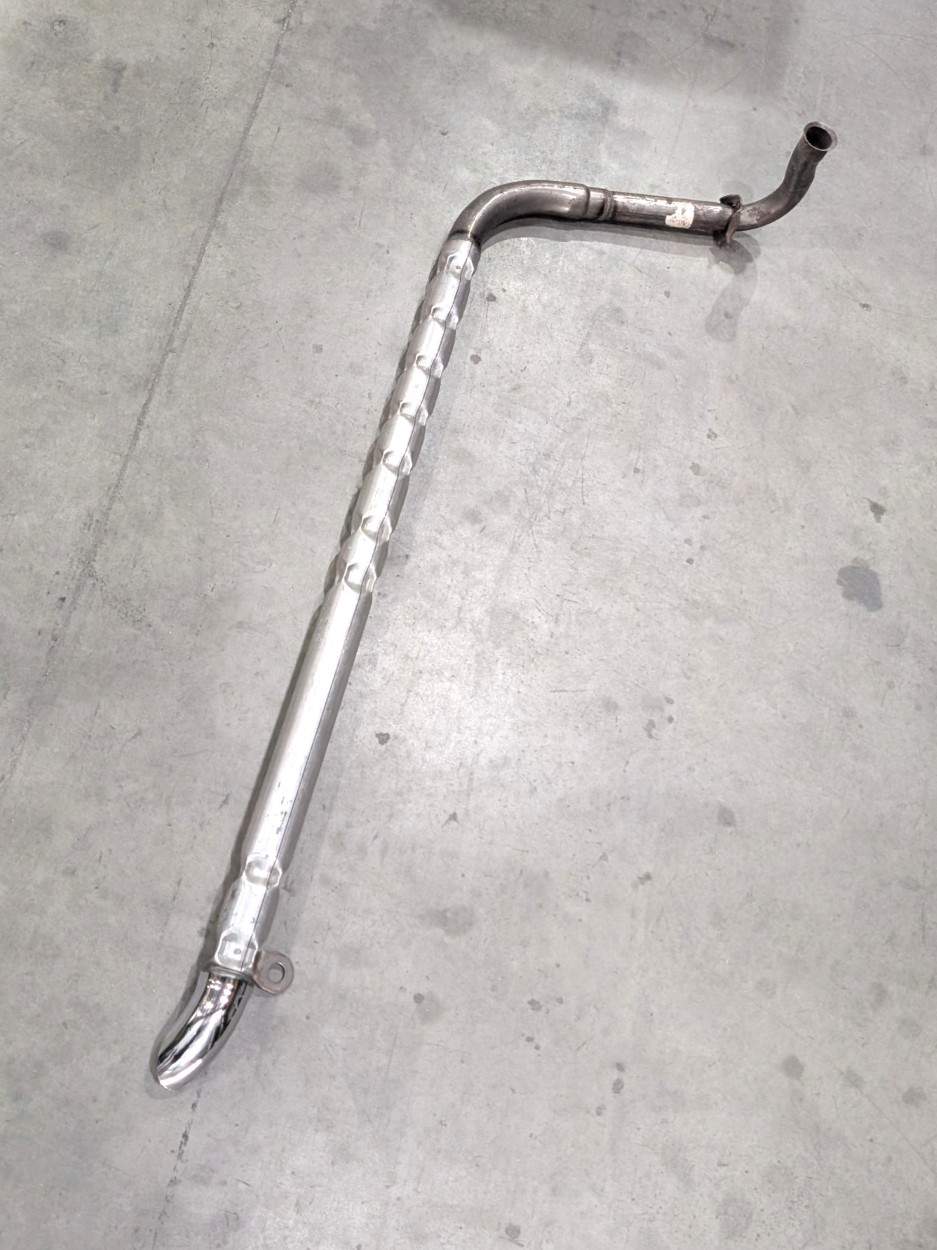
Factory-Correct 1965–1967 Corvette NOS 2.5″ Side Exhaust Assemblies
For high-horsepower midyear restorations, exhaust gas velocity is the primary engineering priority. Between 1965 and 1967, Chevrolet matched high-output powerplants with unrestricted 2.5-inch side exhaust assemblies.
These pipes—bearing GM part numbers 3872971 (RH) and 3872972 (LH)—feature large-diameter primary head pipes designed to mate directly to the high-performance 2.5-inch cast-iron exhaust manifolds. These manifolds were standard equipment on:
- 327 ci Small-Blocks: L76 (365 HP), L79 (350 HP), and L84 Fuel Injection (375 HP)
- 396 ci Big-Blocks: 1965 L78 (425 HP)
- 427 ci Big-Blocks: 1966–1967 L36 (390 HP), L68 (400 HP), L71 (435 HP), L89 (aluminum heads), and the competition L88 (430 HP factory rating)
The 2.5-inch system features compound mandrel curves designed to wrap around the frame outriggers without necking down the cross-sectional area. This maintains maximum gas velocity, allowing high-lift solid and hydraulic camshaft profiles to scavenge the combustion chambers during valve overlap. Builders can inspect the specifications for these 1965–1967 Corvette NOS 2.5″ side exhaust pipes to ensure their chassis retains period-correct flow characteristics and historical pedigree.
Small-Block Manifold Geometry: 1966–1967 NOS 2″ LH Side Exhaust Pipe
While big-block engines demand 2.5-inch pipes, the vast majority of Sting Rays produced were base-engine small-blocks. The 1966–1967 NOS 2″ LH side exhaust pipe (GM #3877215) was engineered specifically for the standard 300-horsepower 327 engine, which utilized 2-inch manifold outlets.
Because small-displacement, standard-cam engines produce lower total exhaust gas volume, maintaining a 2.0-inch primary pipe diameter is vital for engine performance. Upsizing to an oversized pipe on a base 327 causes exhaust gas velocity to drop sharply. This loss of kinetic energy impedes exhaust scavenging at low-to-mid RPM ranges, resulting in flat spots under acceleration and diminished low-end torque.
The left-hand head-pipe routing on midyear Corvettes is one of the tightest packaging spaces on the entire chassis. The pipe must navigate a narrow corridor bounded by:
- The lower edge of the driver-side fiberglass footwell
- The structural cast-iron steering gear box housing and Pitman arm
- The clutch linkage bellcrank (Z-bar) assembly
- The left-hand frame rail and front suspension crossmember
GM #3877215 resolves this clearance challenge with an asymmetric factory mandrel bend that clears the steering box casting throughout its full range of articulation. It also serves as an exact direct-fit replacement for 1963–1965 Corvettes running 2-inch exhaust manifolds when retrofitting side-mount pipes. This avoids the common issue where reproduction pipes press against the steering box casting, transmitting engine vibrations directly into the steering wheel.
Step-by-Step Installation: Aligning Side Exhaust Systems on C2 Frames
Achieving symmetrical alignment and eliminating rattle points requires a methodical installation sequence. The following procedure outlines the steps for mounting an N14 side exhaust system to a midyear chassis:
-
Inspect Exhaust Manifold Studs and Seating Faces:
Clean the cast-iron manifold outlet flange using a wire brush to remove rust and combustion scale. Inspect the reverse-cone bevel. Thread new brass or bronze hex nuts onto the studs to confirm the threads are clean and burr-free. Apply high-temperature copper anti-seize compound to each stud.
-
Position the Head-Pipe and Donut Gasket:
Place a fresh wire-reinforced composite or sintered metal exhaust donut gasket into the manifold outlet recess. Offer up the front pipe flare squarely against the gasket. Do not pull the pipe into alignment using the flange nuts, as uneven torque can fracture the cast-iron manifold ear.
-
Engage the Upper Flange Fasteners Loosely:
Run the nuts up the studs finger-tight so the head-pipe flare supports the gasket, but leave roughly 0.25 inches of play to allow axial rotation and fore-and-aft movement along the frame.
-
Suspend the Mid-Body Mounting Tabs:
Align the side pipe’s welded center mounting brackets with the factory frame outrigger bracket locations beneath the door sill. Insert original-style rubber-and-fabric reinforced vibration isolators between the pipe bracket and the frame mount. Install the cadmium-plated mounting bolts with lock washers, threading them partially into the weld-nuts without fully torquing down.
-
Verify Symmetrical Clearance Gaps:
Measure clearance between the pipe’s internal expansion chamber and the bottom of the fiberglass rocker body panel. Maintain a minimum clearance of 0.50 inches along the entire rocker length. This prevents the thermal output of the exhaust pipe from blistering the fiberglass panel or damaging the exterior paint.
-
Torque Manifold Flange Nuts to Factory Specification:
Working in alternating half-turn increments across the two manifold studs, compress the donut gasket evenly. Torque the fasteners to 25–30 ft-lbs. Visually verify that the flange collar sits perpendicular to the manifold studs.
-
Lock the Frame Outrigger Mounts:
With the forward junction secured, torque the mid-body frame isolator bolts to 18–22 ft-lbs. This ensures that the rubber cushion remains in neutral shear without being twisted or preloaded.
-
Mount the Outer Protective Heat Shields:
Position the cast aluminum-and-fiberglass side exhaust rocker covers over the pipe assembly. Thread the lower and upper mounting screws into the rocker sill channels. Check that the inner insulating fiberglass heat blankets sit flat and do not pinch against the hot exhaust tube walls.
Cabin Climate Systems: 1969–1976 Corvette NOS Blower Switch Mechanics
Restoring a classic Corvette requires matching mechanical authenticity under the chassis with functional accuracy inside the cabin.
The 1969–1976 Corvette NOS fan blower switch with AC (GM #3942657) controls the four-speed cabin blower motor across the center dash console. In vehicles equipped with factory air conditioning (RPO C60), this switch operates as a high-amperage switching hub, directing current through the resistor pack to govern motor speeds:
Modern universal reproduction switches often use stamped, lightweight brass-plated contacts and synthetic casing plastics with lower melting thresholds.
Authentic Delco-engineered NOS GM switches employ solid, heavy-gauge beryllium-copper leaf contacts that withstand continuous electrical loads without warping. Additionally, the internal mechanical detents provide distinct tactile resistance when sliding through fan speed positions, matching the original factory feel.
Frequently Asked Questions About Rare NOS Corvette Side Exhaust Pipes
How do I identify genuine NOS Corvette side exhaust pipes versus reproductions?
Authentic NOS GM side exhaust pipes feature consistent factory mandrel bends with smooth radii and zero internal pipe collapse or crush wrinkling around chassis outriggers. Genuine pipes exhibit GM production traits, including clean flanged ends that mate with exhaust donuts, correct gauge aluminized steel (yielding a distinct, solid ring when lightly tapped), and factory-stamped mounting tabs with clean bracket seams. Reproduction units typically feature thin-gauge steel, cruder weld lines, and pinched sections around bends where universal bending dies were used.
Can I install 2.5-inch side exhaust pipes on a 2-inch manifold Corvette?
No, not without using step-down adapter cones or changing the exhaust manifolds. The factory 2.5-inch side pipes (GM #3872971 and #3872972) feature an inlet flare. This is engineered specifically to mate with 2.5-inch exhaust manifold outlet collectors. Attempting to fit a 2.5-inch pipe against a 2-inch manifold face causes exhaust donut gasket misalignment and severe exhaust gas leaks. To run 2.5-inch pipes, install the correct 2.5-inch high-performance exhaust manifolds or utilize the correct 2-inch side pipe assembly (such as GM #3877215).
Do NOS GM parts deteriorate while sitting in warehouse storage for decades?
NOS exhaust pipes stored in climate-controlled environments do not suffer functional degradation. Heavy aluminized steel protects the tubing from atmospheric oxidation when protected from ambient moisture and liquid water. However, components stored in unconditioned facilities can develop light surface shelf wear or superficial oxidation. At CS of MD West, our NOS inventory is vetted for structural soundness. This ensures that internal baffles, mounting brackets, and seating flares remain in factory-new operating condition.
